Report and Removal Tools on Adult AI Platforms
A platform that hosts user-facing content needs three recovery routes, and knowing them before you need them is the difference between five minutes and five weeks. Crushon provides all three: a report control on each content page, a published content removal policy, and a complaints process that carries a concern further than a general support inbox. The reporting habit at the bottom of this page takes about ten minutes to learn, and the numbers you need to spot the highest-exposure listings are on every card.

Key takeaways
- Three routes exist: the report control on a content page, the content removal policy, and the complaints policy.
- Write the report once and include the essentials: the page, the date, what you saw and what rule you think it breaks.
- Exposure drives urgency: a card with 18.2M views deserves a report before one with 4.7K, because more people see it first.
- Reporting is not the same as complaining. One is about a listing, the other about how the platform handled you.
The three routes and when to use each
The first route is the report control attached to a content page. It is the shortest path, because the report arrives with the page attached and does not depend on you describing where the problem is. Use it for anything about a specific character or listing.
The second route is the removal policy, which describes how content can be taken down and who to contact when the automated route is not enough. It is the one to read before you need it, because the policy explains what kind of request goes where, and a request sent to the wrong place usually just needs resending to the right one.
The third route is the complaints policy, which exists for the case where the problem is not a listing but a process: something you reported and feel was not handled, or a decision you want reviewed. Keeping these three separate is the practical skill, because mixing them is what produces the experience people describe as being passed around.
What to put in a report
A report that gets acted on quickly has four components, and all four are cheap to produce at the moment you notice the problem. The page itself, the date you saw it, a plain description of what is wrong, and the specific rule or guideline you believe applies. The last one is the component people skip, and it is the one that helps most.
| Route | What it covers | What to include | Expected shape of a reply |
|---|---|---|---|
| Report control on the page | A specific character or listing | Nothing beyond the report itself; the page is attached | An acknowledgement, then action on the listing |
| Content removal policy | Requests to take material down | The page, the date and the reason it should not be listed | Confirmation that the request was received and its status |
| Complaints policy | How a concern or a decision was handled | A dated summary of the issue and what you want reviewed | A route to a reviewer rather than a first-line answer |
| Support address | General and compliance contact | The page, the date and the reason it should not be listed | Routing to the right process |
| Compliance statement | What the platform says its content is | Nothing: this is a page to read, not a channel | No reply; it frames what is and is not generated content |
Two rows in that table are easy to confuse. The removal policy is about material being listed, and the complaints policy is about a process being reviewed. If your last message went to support and nothing happened, you are in the third row, and saying so plainly is faster than restating the original problem.
Worked example: using the counters to prioritise
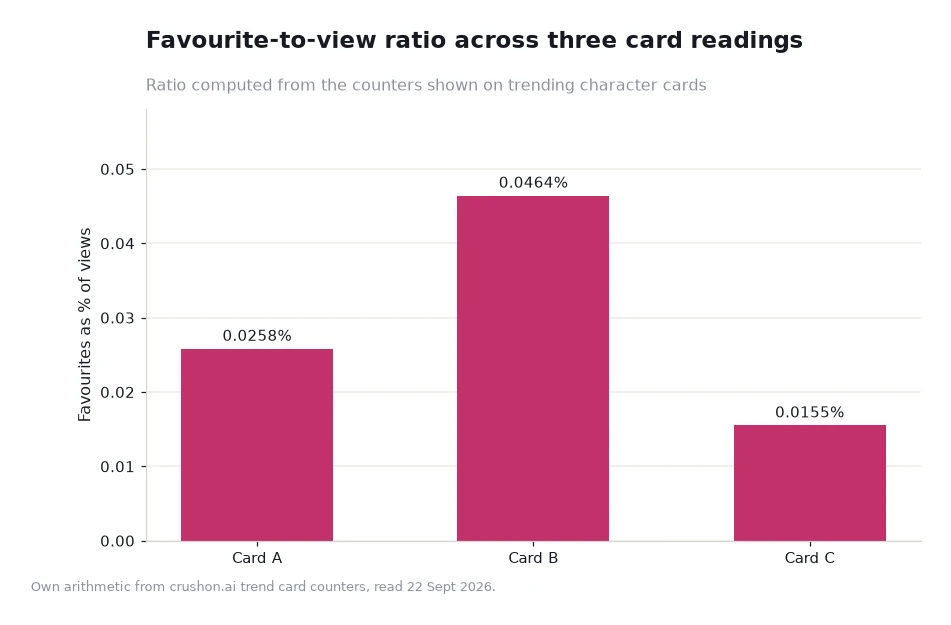
Suppose you notice the same kind of problem on three listings and want to report the one that matters first. The counters give you a rough exposure order, and the arithmetic is the same division used for any card. A listing showing 18.2M views and 4.7K favourites reads 4,700 / 18,200,000 = 0.0258%. A second at 0.0464% and a third at 0.0155% complete the set.
Now read them for the purpose in hand, which is completely different from reading them to choose a character. For a report, the ratio is close to irrelevant: what matters is how many people see the listing, so the card with 18.2M views goes first even though its ratio is not the highest of the three. The ratio describes how people responded; the view count describes how many were exposed, and exposure is the number that sets urgency.
That distinction is worth keeping in mind because it inverts the advice you use elsewhere. When you are choosing something to open, the ratio is the better signal. When you are reporting something, the raw view count is. The three ratios in the chart come from the author's arithmetic on the counters as displayed on 22 Sept 2026 and are not published platform statistics.
Learning the routes without needing them
Fifteen minutes is enough to be prepared. Find the report control on any content page once, so you know where it sits. Read the removal policy, which sets out how a takedown request is handled and where it should be sent. Then read the complaints policy, and save both to a bookmark folder you will remember.
There is one more page worth the visit, and it answers the question people usually have before they ever file a report. The compliance statement sets out that the platform's content is AI-generated text and depicts no real person, which is the context that decides whether a concern is about conduct, about a listing, or about nothing at all. The platform's own pages describe its Sex AI companions in terms of adaptation and recall rather than fixed scripts, which narrows the list of things that can genuinely go wrong: tone, framing, or a listing that should not be there. Most people who type sex ai into a search engine are looking for the platform itself; the tools on this page are what to reach for when something on it goes wrong.
Finally, keep a short record of anything you report: the date, the page, and the route you used. A record turns a second report into a follow-up rather than a fresh start, and it is the single habit that makes the whole system work in your favour.
Frequently asked questions
Where is the report control?
On the content page itself, so a report arrives with the listing attached. Start there for anything about a specific character, and use the published policies only when the request needs to go further.
What is the difference between removal and a complaint?
Removal is about material being listed. A complaint is about how something was handled or decided. Naming which of the two you mean in the first line saves a round trip.
How much detail should a report include?
Four things: the page, the date, a plain description, and the guideline you think applies. More than that is rarely useful, and less than that usually produces a request for clarification.
Do I need to read the policies before reporting?
No, but ten minutes with them makes every later step faster. You will know which route fits, what a reply should look like, and when a follow-up is warranted.
Ten minutes now, a clear path later
Bookmark the removal and complaints pages, find the report control once, and note where the compliance statement sits. Then carry on using the platform.
Like most administration, the value of the preparation is invisible until the day it is not, and on that day it is worth far more than the ten minutes it cost.
Data and sources: content pages, the content removal policy, the complaints policy and the compliance statement as published by Crushon.AI, read 22 Sept 2026[1]. Ratios are the author's own arithmetic on the counters displayed on 22 Sept 2026. Written for adults 18+.