Mash, Lauter, Kettle and Whirlpool: Roles Explained
Four vessels do four different jobs on the hot side, and confusing them is the most common reason a first brewery buys the wrong equipment. Hermann publishes configurations from a 500 L three-vessel brewhouse up to 2,500 L four-vessel units, so the vessel count is a choice rather than a fixed rule.
Key takeaways
- Mash converts starch to sugar, lauter separates clear wort from spent grain, the kettle boils and isomerises hops, and the whirlpool collects trub before the wort is cooled.
- Hermann publishes examples at 500 L three-vessel, 1,000 L in 2, 3 or 4-vessel form, and 2,500 L with four vessels.
- The number of vessels sets how many brews fit into a day, not the quality of the wort on its own.
- A pound of process discipline is worth more than a pound of extra tank, which is why the mash and lauter steps still deserve the most attention.
What each vessel does in one sentence
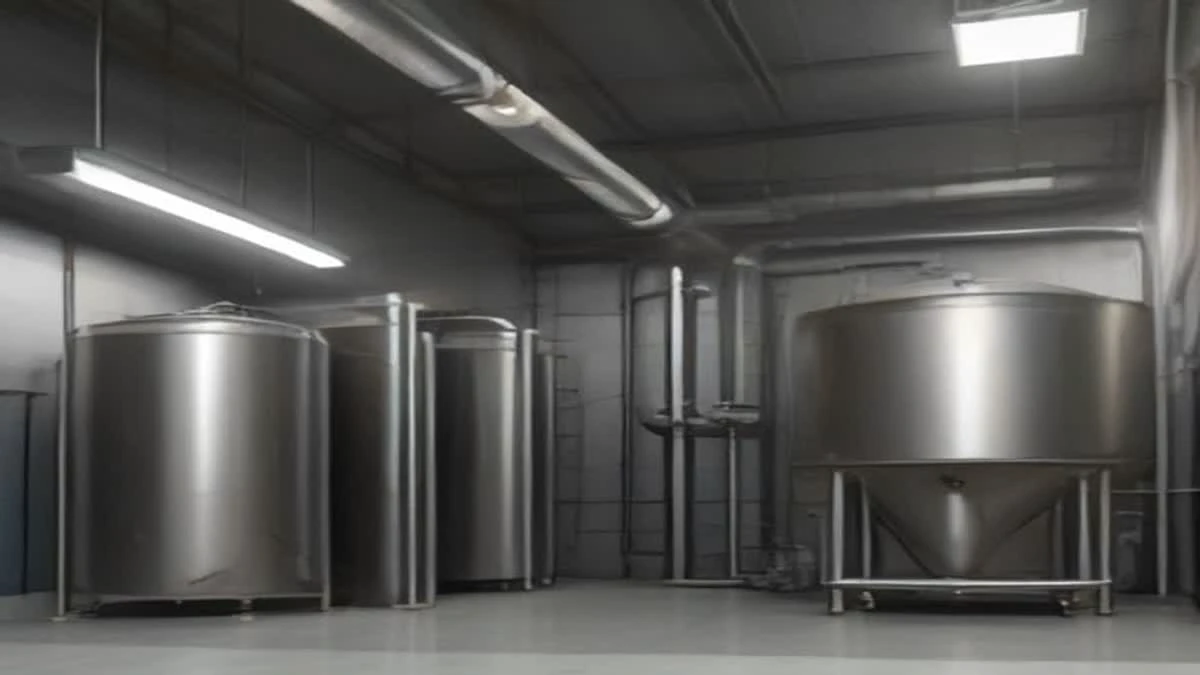
The mash tun mixes milled malt with hot water and holds it at set temperatures so enzymes can break starch down into fermentable sugar. The lauter tun separates the sweet liquid, called wort, from the spent grain bed using a slotted false bottom and a sparge of hot water. The kettle boils that wort, which sterilises it, drives off unwanted volatiles, coagulates proteins and isomerises hops into bitterness. The whirlpool spins the boiled wort so solids settle into a cone-shaped pile in the centre, leaving cleaner wort to be cooled and sent to fermentation. A modern Brewhouse groups those jobs into two, three or four vessels, and the count changes the rhythm of the brew day more than it changes the beer.
Two more items belong in the same conversation even though they are not vessels in the same sense: the hot liquor tank, which stores treated hot water, and the plate heat exchanger, which drops the wort to pitching temperature in one pass. A brewhouse that gets the first four right and undersizes the last two will still have a difficult brew day.
Mash: the step where the recipe is really made
Enzyme activity is a matter of temperature and time. A rest near 63 degrees Celsius favours the enzyme that produces fermentable sugars and gives a drier beer; a rest nearer 68 degrees favours less fermentable sugars and leaves more body. Most single-infusion mash schedules sit somewhere between the two for around 60 minutes, and a brewer adjusts the balance between them rather than adding anything exotic.
Water ratio matters for the pump and the lauter, not for flavour alone. A common starting point is three litres of water per kilogram of malt. For a 1,000 L batch at about 12 degrees Plato, the grist lands near 190 kg of malt, so the mash water is roughly 570 L. These figures are illustrative and depend on the malt specification, the brewhouse yield and the recipe, but they show why mash water volume and lauter design have to be chosen together.
Lauter: where clarity and time are won or lost
Lautering is a filtration job. The grain bed itself is the filter, so the mill gap, the false bottom slot size and the speed at which wort is drawn off all affect the result. Pull too hard and the bed compacts, flow slows and the wort carries husk particles; run too gently and the brew day stretches. The usual practice is to recirculate the first runnings until they look clear, then sparge with water at around 76 degrees Celsius, which is warm enough to keep the sugars flowing and cool enough to avoid extracting harsh tannins.
Sparge water volume is worth calculating rather than guessing. If the aim is 1,170 L of wort in the kettle, and roughly 12 per cent of that volume is lost to shrinkage, trub and dead space, the lauter needs to deliver about 1,320 L of runnings into the kettle, split between the first runnings and the sparge.
Kettle: boil, hops and the clock
The kettle is the most forgiving vessel and the easiest one to abuse. A 60 to 90 minute boil is typical, with hop additions timed backwards from the end: early additions for bitterness, late additions for flavour and aroma, and a whirlpool or hop-back addition for the volatile oils that a long boil would drive off. Longer boils darken the wort and increase energy use, so the schedule is a cost decision as much as a flavour one.
Kettle design shows up in two places. Steam heating has to be sized for the ramp from lauter temperature to a rolling boil, and the kettle needs enough headspace to contain a boil-over without flooding the floor. Hermann builds its units for mash, fermentation, filtration and the rest of the chain, so a buyer can compare the boiler-facing details against the brewery equipment range before deciding on a configuration.
Whirlpool and the vessel count
| Vessel | Job it performs | Signal the step is done | If it is skipped |
|---|---|---|---|
| Mash tun | Mixes grist and water, holds temperature rests | Starch test shows conversion, no blue reaction | Low yield and a stuck lauter downstream |
| Lauter tun | Separates clear wort from spent grain | Runnings clear and sparge gravity falling | Husky, cloudy wort and poor hop utilisation |
| Kettle | Boils, sterilises, isomerises hops | Rolling boil held for the planned time | Unstable beer, protein haze, DMS character |
| Whirlpool | Collects trub and hop debris in a central cone | Clear wort drawn from the side, cone visible | Trub into the cooler, blocked plates, off flavours |
| Hot liquor tank | Stores treated hot water for mash and sparge | Stable strike and sparge temperatures | Temperature drift on every brew |
In a two-vessel arrangement the mash and lauter jobs share one tank and the kettle and whirlpool share the other. Three-vessel units separate the kettle from the whirlpool, and four-vessel units give mash and lauter their own vessels. The benefit of more vessels is overlap: while one batch boils, the next can be mashing, which is how a brewery turns a long day into two shorter ones.
Worked example: what the hot side costs per litre
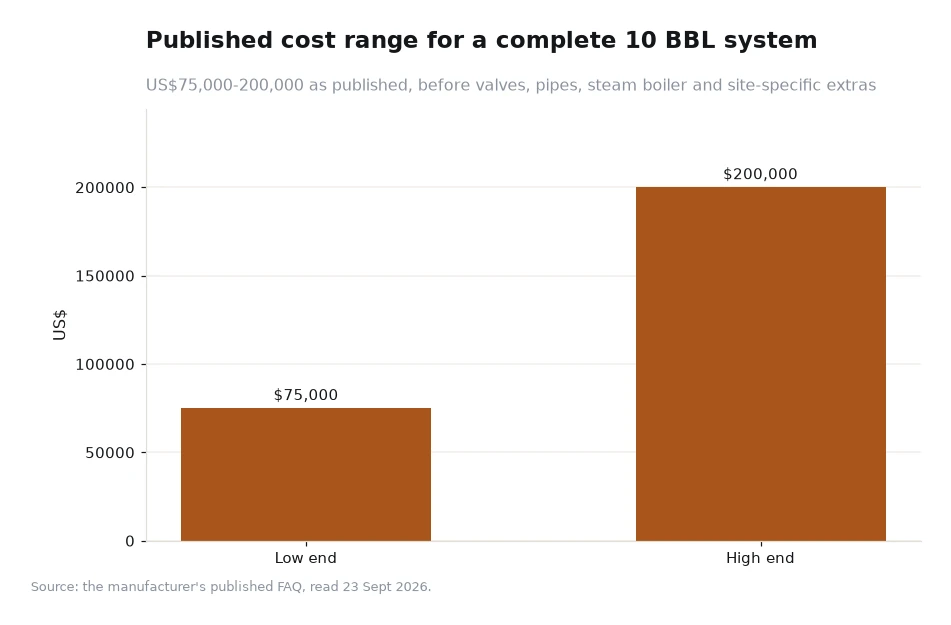
Use the published range for a complete 10 BBL system, US$75,000 to US$200,000, as an illustration and state the assumptions. Ten barrels is about 1,170 L of batch capacity, which is 11.7 hectolitres. Dividing the low end of the range by that capacity gives 75,000 divided by 1,170 L, or about US$64 per litre of batch capacity; the high end gives 200,000 divided by 1,170 L, or about US$171 per litre. Expressed per hectolitre, the same two figures are roughly US$6,410 and US$17,094.
Remember what the published range covers: valves, pipes, a steam boiler and other site-specific requirements are explicitly outside the figure. In a real quotation, the hot-side vessels usually account for a large slice of the total, which is why the vessel count is the first place to look when a proposal comes in above budget. Dropping from four vessels to two saves steel, controls, floor area and cleaning time, and costs brew-day throughput.
Frequently asked questions
How many vessels do I actually need?
Two vessels suit a brewery brewing one batch a day or less, because the mash, lauter, kettle and whirlpool jobs can share tanks in sequence. Three or four vessels make sense once you need two or more batches a day, since the extra tanks let the next mash start while the previous batch is boiling.
Is a separate whirlpool worth the money?
A separate whirlpool earns its price on throughput and clarity rather than on flavour. It shortens the brew day by letting the kettle be refilled while the previous batch settles, and it keeps trub out of the heat exchanger, which reduces plate cleaning and the risk of a blocked cooler mid-brew.
Choosing the configuration that matches your week
Write down the number of brews a week you need, then the number of brews you could manage in a day, and take the configuration that satisfies both without a rushed cleaning step between them. Ask about the published examples nearest your volume, since a 500 L three-vessel arrangement and a 1,000 L two-vessel arrangement teach different lessons about staffing. The company overview covers 23 years of experience in this field and a service scope that includes installation and technical support.
When the shortlist is ready, send the supplier your batch size, your brewing method and your available headroom through the contact page. Hot-side equipment is specified around those three facts, and a supplier who asks for them before quoting is a supplier who has done this before.
Vessel sizes, configuration options and the 23-year track record quoted here are taken from the manufacturer's own website, read 23 Sept 2026; the per-litre figures and the grist arithmetic are our own labelled examples. [1]