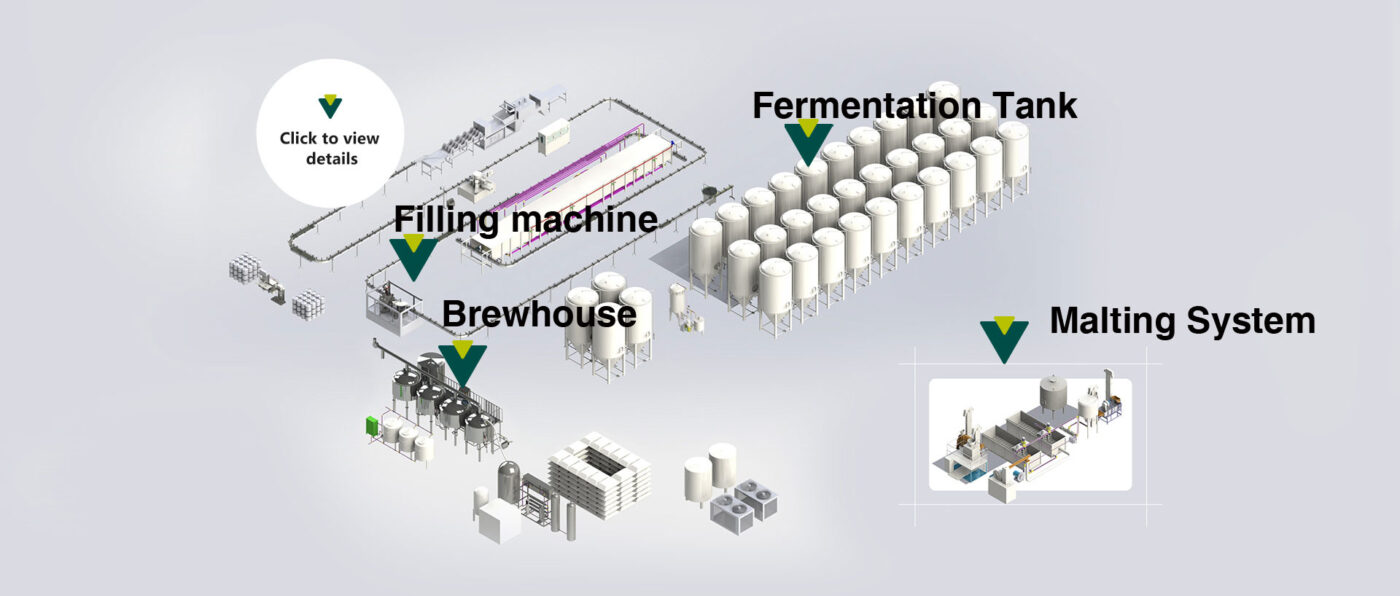
A turn-key brewery controls project cost by fixing more variables before fabrication starts. Equipment capacity, utility demand, piping, controls, installation interfaces, and commissioning requirements are specified under one engineering scope instead of being purchased separately. A 20 hL brewhouse, for example, must be matched with fermentation volume, glycol capacity, hot-water storage, steam supply, pump flow, and electrical service. Brewers Association benchmarking has shown large efficiency differences between breweries: in its 2016 data, breweries below 1,000 bbl/year reported median electricity use of 182 kWh/bbl across 13 breweries. Better system sizing reduces unnecessary equipment, site changes, contractor hours, and delayed production.
A brewery budget can look controlled while major costs remain outside the equipment quotation. A brewhouse package may cover mash, lauter, kettle, whirlpool, pumps, and controls but leave out glycol distribution, steam piping, water treatment, compressed air, process piping, drainage interfaces, electrical work, freight, rigging, and commissioning. Once construction starts, every missing interface has to be purchased locally, often when the project has less flexibility to change its layout.
Turn-key planning reduces that uncertainty by preparing the brewhouse, cellar, utilities, controls, and installation around the same production target. For a brewery planning 2 brews per day from a 20 hL brewhouse, nominal daily wort production is about 40 hL before process losses. If the fermentation schedule later requires 3 brews per day, cellar volume, cooling demand, hot-water recovery, and labor requirements all change with it.
That relationship is why equipment sizing cannot stop at tank volume. A 40 hL fermenter filled with two 20 hL brews may fit the production plan, but cooling capacity has to cover the heat removed during wort cooling, active fermentation, cold crashing, and bright-beer preparation. Installing larger tanks without checking the refrigeration system can move spending from the tank purchase to a later chiller replacement.
A brewery does not pay only for installed stainless steel. It pays for every pipe, cable, utility connection, contractor hour, test, and production day required to make that stainless steel usable.
The same principle applies to beer brewing equipment selection. A lower vessel price has limited relevance if the package requires additional pumps, different electrical components, new valve standards, custom adapters, or locally fabricated platforms. Total installed cost is more useful than equipment purchase price alone.
Layout work has a measurable effect on that installed cost. Long product lines require more stainless tubing, welds, fittings, insulation, supports, cleaning volume, and installation labor. A tank placed 8 m farther from a manifold does not add only 8 m of pipe; supply and return routes, bends, supports, instrument connections, and cleaning paths can multiply the added material.
Space also affects future spending. Leaving one planned fermenter position, an accessible pipe header, and electrical cabinet capacity can cost relatively little during initial construction compared with moving installed vessels later. A brewery commissioned in 2026 with room for four additional tanks can expand cellar capacity without rebuilding the original production area, provided cooling, structure, drainage, and utility connections were sized for that option.
Utility engineering deserves the same attention because brewery energy use varies sharply with scale and operating practice. The Brewers Association energy manual lists typical electrical use of about 12–22 kWh/bbl and natural-gas use of about 1.3–1.5 therm/bbl for breweries in its reference ranges. It also notes that electricity may represent only about 30% of energy consumed while accounting for a much larger portion of energy spending.
| System | Engineering check before purchase | Cost problem when undersized or oversized |
|---|---|---|
| Glycol cooling | Peak simultaneous cooling demand, tank count, crash schedule | Slow cooling or oversized chiller and pumps |
| Steam or heating | Brewhouse size, heat-up time, brews per day | Longer brew cycle or unused boiler capacity |
| Hot water | Strike water, sparge water, CIP demand, recovery | Waiting between batches or excess storage |
| Pumps | Flow, head pressure, pipe diameter, product type | Slow transfers, cavitation, unnecessary motor size |
| Electrical supply | Connected load and starting current | Panel upgrades after equipment arrives |
| CIP | Tank size, circuit length, chemical volume | Longer cleaning cycles and excess chemical use |
Water consumption provides another example of why system design matters. In the Brewers Association’s 2016 benchmarking update, the 0–1,000 bbl/year group had 11 reporting breweries for water use; the median was 34 barrels of water per barrel of beer, while the upper and lower portions of the range differed substantially. The association also noted that many small brewpub figures included restaurant consumption, so the result should not be treated as a universal brewery target.
The useful lesson for project budgeting is the spread between facilities, not one target number. Tank rinsing, floor cleaning, keg washing, CIP design, hose practices, wort losses, packaging, and cooling methods change water and wastewater volumes. Engineering a brewery around realistic water flows allows drains, hot-water tanks, pumps, treatment systems, and wastewater connections to be sized before concrete, piping, and equipment positions are fixed.
Wastewater can add costs that are rarely visible in the main equipment price. The Brewers Association reported that participants in its 2017 sustainability benchmarking program had collectively paid more than $1 million in high-strength wastewater surcharges related to biochemical oxygen demand and total suspended solids over the preceding three years. Energy represented roughly 70% of utility costs for participating breweries across production ranges.
Those numbers make process losses part of financial planning. Sending concentrated yeast, trub, beer, or cleaning residue directly to the sewer can increase wastewater strength even when total water volume stays similar. A turn-key design can specify collection points, drain routes, side-stream handling, tank geometry, and cleaning sequences before the floor and piping layout are built.
Factory preparation controls another group of costs: field modification. Pumps, valves, instrumentation, electrical cabinets, skid piping, and automation can be assembled and checked before shipment. Factory Acceptance Testing can verify motor direction, valve response, temperature inputs, level signals, pump interlocks, alarms, recipes, and communication between the human-machine interface and PLC before installation crews are working on site.
A wiring mistake found at the factory may require one technician and a short correction. The same problem found during commissioning can involve an electrician, automation engineer, mechanical contractor, and brewery operator at the same time. If a production start is delayed by 5 working days, labor continues while the brewhouse produces no saleable beer.
Shipping design matters as well. Vessel diameter, overall height, skid dimensions, door openings, crane access, unloading equipment, and container limits should be reviewed before manufacturing. A tank that cannot pass through a finished doorway can require wall removal or additional rigging. Checking a 3,000 mm vessel diameter against the actual building route costs little on a drawing and much more after delivery.
Turn-key purchasing can also reduce component variation. A brewery using one or two standardized sanitary-valve families, common temperature sensors, consistent motor brands, and a defined set of pump seals carries fewer spare parts than a plant assembled from many unrelated packages. The financial effect appears later through maintenance stock, technician time, and shorter equipment stoppages.
Automation should be sized with the same restraint. A small brewery producing 1 or 2 brews per day may not need every valve automated, while a facility operating repeated multi-brew schedules can gain more from recipe control, automatic temperature regulation, transfer interlocks, and CIP sequencing. Paying for unused automation raises capital cost; too little control can increase manual labor and batch variation.
Clear scope boundaries make supplier quotations easier to compare. Instead of asking only for the price of a 20 hL brewhouse and 10 fermenters, buyers can request the same boundary from every bidder: tanks, platforms, process piping, glycol distribution, controls, instrumentation, commissioning, documentation, spare parts, and installation supervision. A 10% lower equipment quote can stop being cheaper once several excluded systems are added locally.
Documentation also carries a measurable service cost. Accurate P&IDs, electrical drawings, valve lists, equipment manuals, spare-parts lists, and utility schedules shorten troubleshooting because technicians can identify the installed component and its connection without tracing the plant manually. When another fermenter is added in 2028, engineers can check pipe size, cooling capacity, electrical reserve, and control I/O before ordering equipment.
Commissioning closes the gap between installed equipment and commercial production. Water trials can verify flow, leaks, pump operation, valve positions, temperature measurement, heating, cooling, CIP coverage, alarms, and control sequences before wort is introduced. Pressure vessels and safety devices must also follow the applicable local codes and manufacturer procedures rather than being treated as general startup checks.
A useful purchasing comparison therefore records more than vessel count. One column should show included equipment, another should show excluded site work, and additional columns should record utility capacity, automation scope, installation responsibility, testing, warranty boundaries, documentation, and commissioning. Comparing 3 suppliers on the same scope exposes cost differences that a simple equipment-price comparison misses.
Production planning should then be checked against that scope. If annual output is expected to rise from 5,000 bbl to 8,000 bbl within 3 years, tank positions, glycol headers, electrical cabinet capacity, and cellar pipework can be prepared for expansion without purchasing all future vessels on day one. Spending is staged while the installed infrastructure remains usable.
A turn-key contract works best when every interface is written down before manufacturing: who supplies steam piping, who terminates electrical cables, where the glycol boundary ends, who provides CO₂ regulation, who connects drains, who performs insulation, and which party conducts startup tests. Removing ambiguity at those interfaces reduces change orders after fabrication has already started.