Between an approved formula and a sealed bottle sits a sequence of checks that nobody sees and everybody depends on. Safety assessment, container compatibility, stability, pilot production and release testing each answer a different question, and skipping one does not remove the risk — it moves it to the customer. The useful habit is to ask which checkpoints exist, who signs them, and what evidence survives the batch.
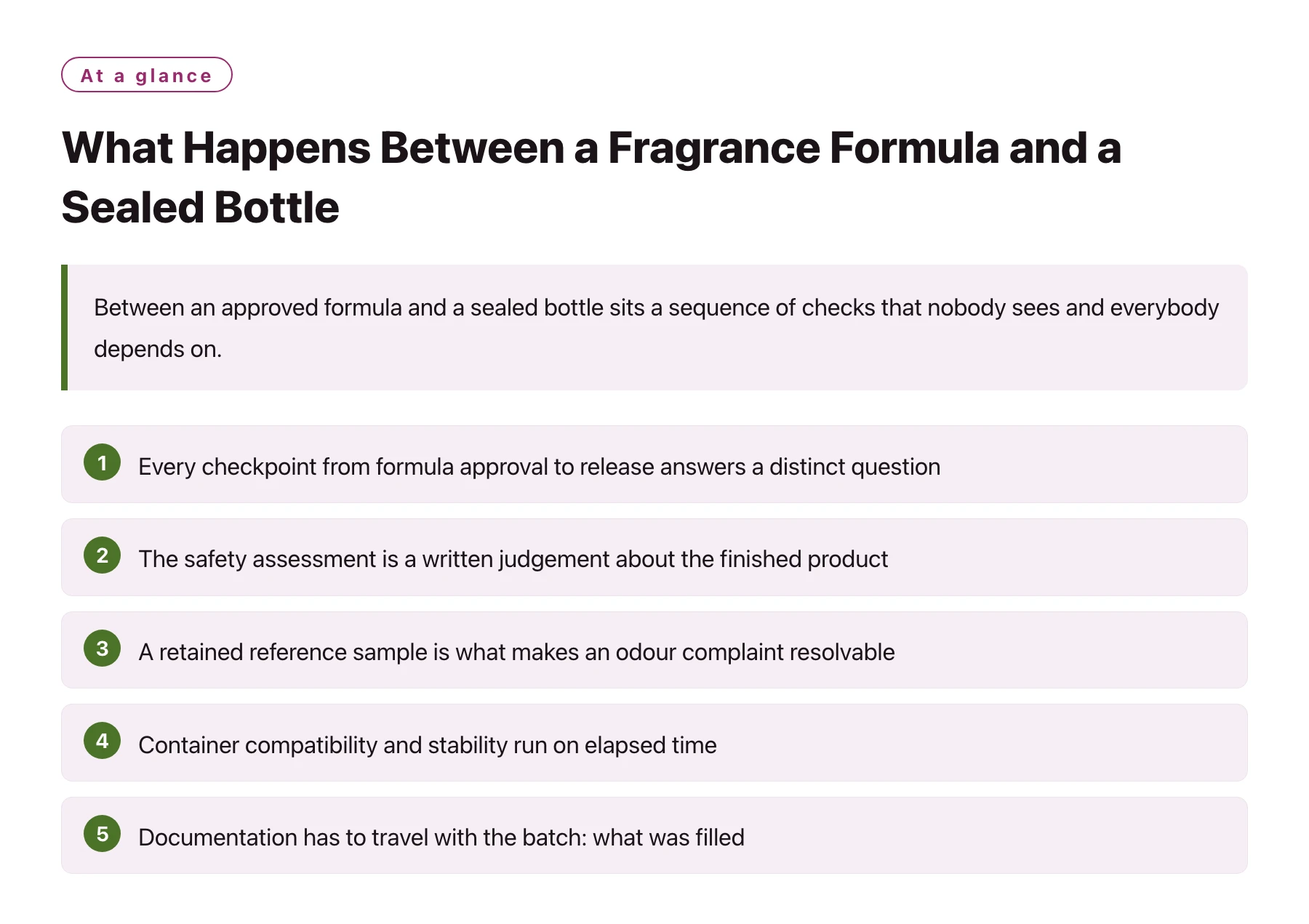
Key takeaways
- Every checkpoint from formula approval to release answers a distinct question, so they cannot substitute for one another.
- The safety assessment is a written judgement about the finished product, not a statement about any single ingredient.
- A retained reference sample is what makes an odour complaint resolvable, because it converts a memory into evidence.
- Container compatibility and stability run on elapsed time, which is why they belong early in the schedule rather than late.
- Documentation has to travel with the batch: what was filled, from which bulk, against which reference, on which date.
Brands usually discover the production sequence from the outside. They see a formula, then a sample, then a shipment, and the steps in between appear only when something goes wrong and someone asks a question nobody can answer.
The sequence itself is not complicated, but it is sequential for a reason. Each checkpoint assumes the previous one is settled, and moving them around is how projects end up with a beautiful bottle whose contents can no longer be defended.
What follows is the order of checks, what each one is for, and the evidence worth requesting before a batch is released.
The logic of the checkpoints
A perfume moves through three kinds of verification: whether the formula is allowed to be sold, whether it survives its container and its shelf life, and whether the batch that was produced matches the batch that was approved. Those three questions belong to different people and use different methods.
Understanding the split makes the paperwork legible. When a brand asks a factory for the safety assessment, the stability report and the batch record, it is asking three separate questions that happen to share a folder.
Permission comes first
Before scale, the formula is checked against the restrictions that apply to fragrance materials, which the International Fragrance Association publishes as standards covering use limits by product category [1]. A formula can smell excellent and still be unusable at the intended dose.
The output of this stage is a decision about the formula, and it should be recorded before sampling continues. Rebuilding a formula after packaging has been ordered is one of the most expensive mistakes available.
Survival comes second
Compatibility and stability testing ask what the product does to its container and what time does to the product. Colour shift, separation, seal degradation and label lifting are the usual findings, and each one has a remedy if it is found early enough.
Scientific committees advising European regulators publish opinions on fragrance materials and skin sensitisation, which is the kind of source that informs how allergen questions are handled [2]. The practical point for a brand is simpler: ask which materials in the formula are subject to declaration and at what level.
Reproduction comes last
The final question is whether what was made matches what was approved. That comparison requires a retained reference, a defined method and a signed record. Without a retained sample, an odour complaint becomes a discussion about recollection.
The checkpoints, in the order they should happen
- Formula approval against material restrictionsConfirm the dose of every restricted material sits inside its limit for the product category before the formula is frozen.
- Safety assessment of the finished productObtain the written assessment that supports placing the product on the market, prepared by a qualified assessor.
- Container and closure compatibilityFill the intended pack with the intended formula and observe what the two do to each other, including the label and the seal.
- Stability over the intended shelf lifeStore samples under realistic conditions and inspect at intervals for colour, clarity, odour and packaging integrity.
- Pilot or first bulk against the referenceCompare the bulk to the approved reference for odour, appearance and key physical measures before the full run is committed.
- Fill and release checksVerify fill weight, seal integrity, spray or applicator function and pack appearance, then release only against written criteria.
- Retain and fileKeep a retained sample from each batch and file the records so a question two years later can be answered with evidence.
What each checkpoint verifies and what to ask for
| Checkpoint | The question it answers | Evidence worth requesting |
|---|---|---|
| Restricted material review | Is this formula permitted at this dose in this product category? | A statement of the restrictions applied and the headroom left in the formula |
| Safety assessment | Can this finished product be placed on the market, and on what basis? | The assessment document and the qualifications of the person who signed it |
| Compatibility trial | Does the product damage the pack, or the pack damage the product? | The trial protocol, the container details and photographs of the findings |
| Stability study | What does time and temperature do to this product? | Storage conditions, inspection intervals and the recorded observations |
| Bulk comparison | Does the produced batch match the approved reference? | The retained reference, the comparison method and the signed result |
| Release inspection | Is this specific batch fit to ship? | Fill and seal checks, defect criteria and the release signature |
Notice that every row asks for a record rather than a reassurance. The distinction matters when a buyer changes, when a retailer requests documentation, or when a batch behaves differently and nobody remembers what was agreed. Testing laboratories that serve the cosmetics sector work to defined methods for exactly this reason, so the methods can be compared between suppliers [3].
Odour approval is the checkpoint brands most often leave informal, and it is the one that causes the longest arguments. A nose is not a measuring instrument, so the process has to supply what the nose cannot: a retained reference sample, a defined evaluation method, and a small panel that assesses the batch blind against the reference rather than knowing which sample is which. If your manufacturing partner cannot describe how that comparison is run, the approval is a matter of opinion, and opinions change with the person doing the smelling. Agree the method while the project is calm, and write the acceptance criteria into the specification.
Where quality quietly leaks out
Most quality failures in fragrance production are not dramatic. They are small drifts that were individually reasonable and collectively changed the product.
All three of the common ones are preventable with the same instrument: a written specification and a retained sample that nobody is allowed to reformulate around.
Changing the formula after approval
Substituting a material because of availability, cost or a supply interruption is normal industry practice. Doing it without re-running the affected checkpoints is not. Every substitution needs its own restriction check, compatibility confirmation and, where the odour is affected, a fresh comparison to the reference.
Ask to be told about substitutions before they are made, and make that expectation explicit in the quality agreement. Manufacturers such as Xuelei in Guangzhou state that they hold ISO 22716, GMPC, ISO 9001, ISO 14001 and ISO 45001 and meet HALAL requirements; a published certification position like that is the starting point for the checks above rather than a replacement for them.
Batch-to-batch drift
Natural materials vary between harvests, and even synthetic materials have tolerance ranges. Drift becomes a problem when nobody notices it accumulating, which is why the retained reference should be a fixed physical sample rather than the most recent batch.
If you want the sequence laid out end to end, from formula to finished bottle walks through what is decided at each step and where a brand's approval is genuinely required.
Releasing under time pressure
When a shipment is late, the temptation is to release a batch against an incomplete result. That decision is sometimes defensible and should always be written down, with the missing result noted and the risk accepted by a named person.
A silent shortcut is the version that reappears later as an unexplained complaint, long after anyone remembers the choice that was made.
Sources
- IFRA Standards Library (International Fragrance Association) —— The IFRA Standards Library lists the restrictions the fragrance industry applies to individual fragrance ingredients, based on safety assessments; it is the reference point for compliant fragrance formulation.
- EU Scientific Committee on Consumer Safety (SCCS) —— The EU scientific committee that issues opinions on the safety of cosmetic ingredients, including fragrance allergens and their labelling thresholds.
- SGS: Cosmetics, Personal Care & Household Testing —— Testing, inspection and certification services for cosmetics and personal care, including microbiological, stability and safety testing aligned with cosmetics GMP.
Frequently asked questions
What is a fragrance safety assessment and who prepares it?
It is a written evaluation of the finished product that supports placing it on the market, covering the formula, the intended use, the concentration and the packaging. It is prepared by a qualified assessor, and in the EU it forms part of the product information file held by the responsible person.
How long does stability testing take, and can it be faster?
It depends on the shelf life being claimed and on the storage conditions used. The test can be started earlier on a near-final formula, which is a legitimate way to save calendar time, but shortening the observation itself removes the information the study exists to provide. Decide that trade-off deliberately.
Why do I need a retained reference sample?
Because odour comparison needs a fixed point. A retained reference lets a later batch be judged against the product that was actually approved, rather than against someone's memory of it. Keep one from every batch and store it so it does not change.
Can a manufacturer change the formula without telling me?
It should not, and the development agreement should say so. Material substitutions happen for supply and cost reasons, but they can change restriction headroom, container compatibility and odour. Ask for notification before substitution and for the relevant checks to be repeated afterwards.
What documents should accompany each production batch?
At minimum, a batch record identifying the bulk used and the fill date, the release result against the specification, and confirmation that the batch was compared with the retained reference. Market-specific documents such as the safety assessment are project level rather than batch level.